Posting Content but No Clients? The Real Reason
The short answer: If you're posting, filming and publishing every week and it still isn't turning into clients, the problem usually isn't how much content you make or how good it is. It's that your message doesn't match how much your buyer already knows. Most expert-led businesses speak to everyone in one register, usually "teaching", and never move people from interested to ready. Work out which stage of awareness each audience is at, write to that stage, and give every piece of content a next step that fits it.
You've done what everyone told you to do. You post on LinkedIn most days. You've got a podcast, a YouTube channel or a newsletter, maybe a book. People like your posts, share your videos and tell you at events that they love your stuff. And yet your calendar of sales calls looks much the same as it did last year.
That gap between visibility and clients is one of the most frustrating places to be in an established business, because it feels like you're doing everything right. I've seen it from both sides. Years ago I grew BBC Top Gear's Facebook page to 10 million followers. For a TV show, that reach was the whole point. For an expert business, 10 million people liking your posts with no route to buy would just be a very expensive hobby. I see a smaller version of it all the time with founders who come to us: a real following, a book, a podcast, full event rooms, and a sales calendar that barely moves.
The good news is that it's rarely a talent problem or an effort problem. It's a matching problem, and there's a 60-year-old idea that explains it better than anything I've found since.
Why isn't my content turning into clients?
Your content usually isn't turning into clients because it's written for one kind of buyer, while your audience holds several. Some don't know they have a problem yet. Some are comparing options. A few are ready to buy today. If everything speaks to the same imaginary middle, most never hear what moves them on.
Look at what most expert-led businesses publish. It's mostly education: tips, frameworks, lessons, opinions. That's valuable, and it builds an audience. But education on its own only serves people at one point in their thinking. The person who's never considered the problem scrolls past because it doesn't feel relevant. The person who's ready to hire someone gets another free lesson instead of a reason to book a call.
The usual advice is to post more, niche down or add a call to action. Those can all help. But they don't tell you what to say to whom, and that's the real question.
What are the five stages of awareness?
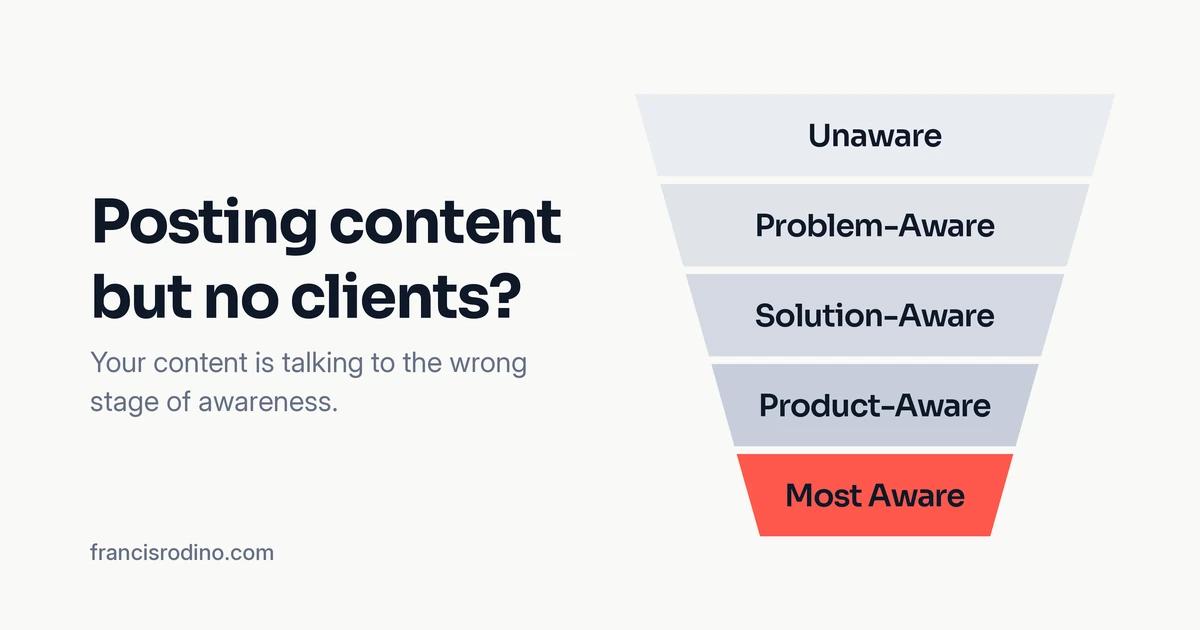
The five stages of awareness are a way of grouping buyers by what's in their heads, not by who they are. Eugene Schwartz described them in his 1966 book Breakthrough Advertising. They run from Unaware, through Problem-Aware, Solution-Aware and Product-Aware, to Most Aware, and each stage needs a different opening message.
Here's what each stage means for an expert-led business:
- Unaware. They don't know they have a problem. A founder who thinks slow growth is just "a tough market" isn't looking for help.
- Problem-Aware. They feel the pain but don't know a fix exists. They know leads are drying up but assume that's normal.
- Solution-Aware. They know the kind of result they want, and maybe the kind of help, but they don't know about you.
- Product-Aware. They know what you offer but aren't convinced it's right for them yet.
- Most Aware. They know you, trust you and want what you sell. They just need the right offer and a clear way to say yes.
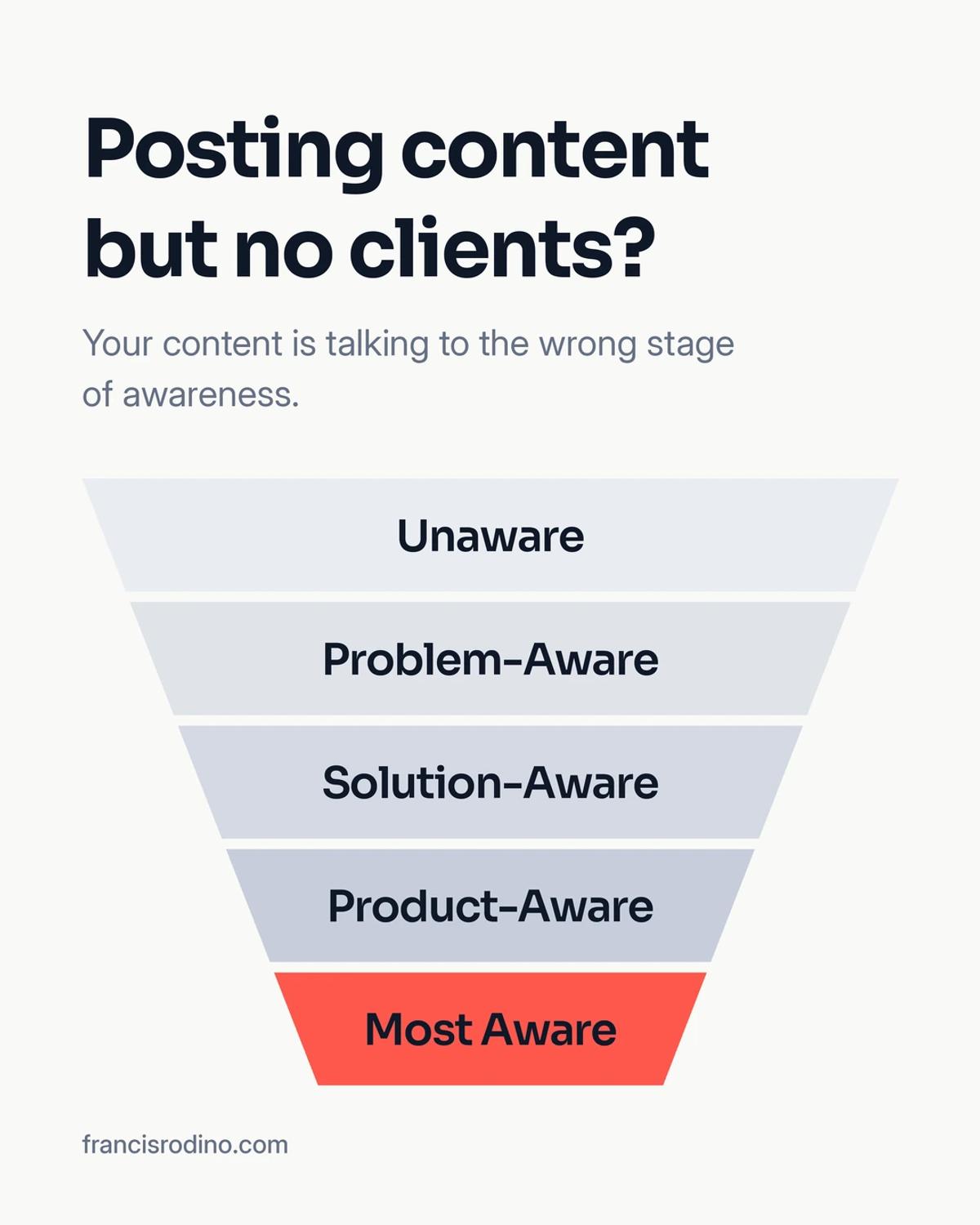
The hand-drawn pyramid at the top of this article is how I picture it. The widest band is the Unaware crowd at the top, and it narrows down to the small group who are ready to buy. The more aware someone is, the less you need to say before you ask.
Schwartz's own rule for headlines was simple. If the prospect already knows your product and that it can satisfy their desire, you start with the product. If they only know the desire, you start with the desire. If they only know the problem, you start with the problem.
Why doesn't posting more content fix it?
Posting more doesn't fix it because volume can't create demand that isn't there, and it can't move someone through stages they're being skipped past. More of the same message reaches more people at the wrong stage. You get more likes and more followers, but the share of people who become clients barely moves.
Schwartz made this point in the opening chapter of Breakthrough Advertising:
"Copy cannot create desire for a product. It can only take the hopes, dreams, fears and desires that already exist in the hearts of millions of people, and focus those already existing desires onto a particular product."
That's a useful reset for anyone who feels they need to persuade people harder. Your job isn't to make founders want growth, credibility or a business that doesn't depend on them. They already want those things. Your job is to connect that existing desire to your way of getting there, in language that matches where they are right now.
How do I tell which stage of awareness my audience is at?
You tell which stage someone is at by listening to how they describe their situation, not by where they sit in your funnel. Someone who says "sales are flat" is Problem-Aware. Someone asking "should I hire a fractional CMO or an agency?" is Solution-Aware. Someone asking about your pricing is Product-Aware or Most Aware.
This is where many marketers go wrong. They assume cold traffic is always unaware and warm traffic is always ready. It isn't that tidy. As the adlibrary glossary on levels of awareness puts it, awareness describes what's in someone's head, while funnel stage describes where they sit in your pipeline. A stranger who's never heard of you can be actively searching for exactly what you do. Someone who's been on your newsletter for two years can still be comparing approaches.
So match the hook to the head, not the funnel. A few practical ways to find out:
- Read your DMs and enquiry forms. The words people use tell you what they already understand.
- Listen to sales calls. On first calls, the question I hear most is some version of "we're doing all the right things, so why isn't it turning into sales?" That's a Problem-Aware buyer. They can feel the gap but can't see the cause yet.
- Check what people search for. Problem phrases ("why are my sales flat") sit lower down the pyramid than solution phrases ("best way to generate B2B leads").
- Ask. A one-question poll or a reply-to-this email can tell you a lot.
What should I say at each stage of awareness?
At each stage you should say the one thing that moves the reader to the next stage, and nothing more. Unaware readers need a situation they recognise. Problem-Aware readers need their pain named and explained. Solution-Aware readers need your approach compared with the alternatives. Product-Aware readers need proof. Most Aware readers need a clear offer.
Here's how that looks across four channels most expert-led businesses already use.
Unaware: start with a situation they recognise
- LinkedIn post: a story or observation they'll see themselves in, such as the founder who's "busier than ever" but whose revenue hasn't moved in three years. No pitch.
- Email: a short story with one idea and a question at the end. The goal is a reply or a read, not a click.
- Webinar or workshop invite: usually too early. If you do invite, lead with the symptom they feel, not the topic you teach.
- Sales page: rarely the right place for this reader. If they land there, open with the situation before you mention any offer.
Problem-Aware: name the pain and explain why it happens
- LinkedIn post: "Here's why your content gets likes but not enquiries." Explain the cause in plain language.
- Email: validate the struggle, then teach the one reason it keeps happening.
- Webinar or workshop invite: promise to explain the problem and what's causing it. That's a strong reason to turn up.
- Sales page: open with the problem, show you understand it better than they do, then introduce the idea that it can be fixed.
Solution-Aware: show why your approach works better
- LinkedIn post: compare approaches honestly. For example, why more ad spend rarely fixes a conversion problem, and what does.
- Email: explain your method and what makes it different. This is where a named framework, such as my RED Method, earns its place.
- Webinar or workshop invite: promise a walkthrough of how the approach works and who it's for.
- Sales page: lead with the result they want, then show your mechanism and why it beats the alternatives they're weighing up.
Product-Aware: answer the objections and show proof
- LinkedIn post: a client story or a before-and-after. For example, we built the live workshop revenue system for Book Magic AI, Daniel Priestley's AI book coaching company, and it doubled their monthly revenue in two months.
- Email: tackle one objection per email, such as price, timing or "we tried something like this before".
- Webinar or workshop invite: a Q&A or a case study session aimed at people already considering you.
- Sales page: testimonials, specifics, what's included, what isn't, and who it's not for.
Most Aware: make the offer and make it easy
- LinkedIn post: a direct invitation. "I've got two places open in January. Here's what's included."
- Email: short and clear. Offer, terms, deadline and one link.
- Webinar or workshop invite: an implementation session or an offer for existing attendees.
- Sales page: price, terms, the next step and nothing in the way. Don't make ready buyers read the whole education again.
Which awareness mismatches are costing me clients?
The mismatches that cost expert-led businesses the most are educating forever and never asking, pitching price to people who don't know they have a problem, and over-explaining to people who are already ready to buy. Each one wastes the attention you've earned, and each one is easy to fix once you can see it.
1. Educating forever and never asking. This is the most common one. Your content is great for Problem-Aware readers, so you attract a big audience of them. But you never give the more aware readers a reason or a route to buy. They wait for an invitation that doesn't come. Book Magic AI had a database full of people who already knew the brand. We ran two reactivation campaigns that gave them a clear offer and a reason to act now, and they produced 96 sales and £48k in cash collected. Those buyers had been there all along. They just hadn't been asked.
2. Pitching price to cold, unaware people. Running an offer, a discount or a "book a call" ad to people who've never thought about the problem. To them it's noise. You haven't jumped one stage, you've jumped four.
3. Over-explaining to ready buyers. Someone's been following you for a year, they've read the book and they want to work with you. Then your sales page makes them sit through the whole education again before they can find the price. Ready buyers want a short path. A long one gives them time to talk themselves out of it.
There's a fourth mismatch that's less obvious: a slow response once someone does put their hand up. If your content finally gets a Most Aware buyer to enquire and they wait days for a reply, the awareness work is wasted. I wrote about that in why slow lead response is costing you sales.
The rule underneath all of these is simple. Don't jump stages. Move people one stage at a time, and let your content mix cover every stage over a month rather than every stage in one post.
What is market sophistication, and why does it matter?
Market sophistication is how many similar promises your market has already heard. Awareness tracks what one buyer knows about their problem and your offer. Sophistication tracks how crowded and sceptical your whole category is. You need both, because a perfectly matched message can still fall flat if it sounds like every other promise in your space.
Schwartz paired the two ideas in Breakthrough Advertising. In a fresh market, a simple, direct claim can work. In a crowded one, buyers have heard "more leads" and "predictable growth" so many times that the words bounce off. You need a new explanation of how the result happens, or you need to speak directly to who the reader is and wants to become.
For most established expert businesses, the market is very sophisticated. Your buyers have hired agencies, bought courses and sat through webinars before. By the time they talk to me, most have already paid an agency for ads, bought a CRM nobody fully uses and done a funnel course or two. They've heard every promise going. That's why your mechanism, your point of view and your proof matter more than louder claims.
How do I start turning content into clients this month?
Start by sorting what you already publish into the five stages, then fill the gaps. Most businesses find they've got plenty of Problem-Aware content, very little for Product-Aware and Most Aware readers, and no clear next step between them. Fixing that balance often matters more than creating anything new.
A simple four-step audit:
- List your last 20 pieces of content. Posts, emails, videos, episodes.
- Tag each one with a stage. Be honest. Most will land in Problem-Aware or Solution-Aware.
- Spot the gaps. If nothing speaks to Product-Aware or Most Aware readers, that's likely where your clients are getting stuck.
- Add a next step to every piece. Each stage needs its own next step. A newsletter sign-up suits Problem-Aware readers. A case study suits Product-Aware readers. A call or a direct offer suits Most Aware readers.
Then plan a month that covers every stage, with more weight on the stages your audience is missing. My rule of thumb is at least one piece a week for Product-Aware or Most Aware readers, and a direct offer at least once a month. If you're not asking monthly, your readiest buyers are left waiting.
FAQ
Why do people like my content but never book a call?
Usually because your content serves people who are learning about the problem, but it never gives people who are ready a clear reason or route to buy. Add content that tackles objections and shows proof, and make a direct offer regularly.
Who was Eugene Schwartz?
Eugene Schwartz was an American direct-response copywriter. His 1966 book Breakthrough Advertising set out the five levels of awareness and the idea of market sophistication, and it's still widely read by copywriters and marketers.
Is the stages of awareness model the same as a sales funnel?
No. A funnel describes where someone sits in your pipeline. Awareness describes what they already know. A cold prospect can be ready to buy, and a long-time subscriber can still be comparing options, so write to what's in their head.
How much content should I create for each stage of awareness?
There's no fixed ratio that suits every business. Audit what you publish now, find the stages you're missing and weight your plan towards them. Over a month, aim to give readers at every stage something to read and a next step.
Does the stages of awareness model work for B2B and high-ticket services?
Yes. It describes how people make decisions, so it applies to a consultancy or an expert agency as much as to a product. High-ticket buyers often stay longer in the Solution-Aware and Product-Aware stages, so proof and objection handling matter more.
Where to go from here
If this has made you look at your content differently, start with the audit above. It takes an afternoon and it'll show you where people are getting stuck.
If you'd like to go further, my book Leads Machine sets out the full RED Method, and the Lead Hero Revenue Leak Scorecard takes about five minutes and shows where your leads are leaking. And if you'd rather talk it through, you can find out how we could work together.
About the author: Francis Rodino is a Fractional CMO, speaker and the author of Leads Machine. He works with founders of expert-led businesses on demand generation, revenue systems and automation. He's spent more than 20 years where marketing meets technology, starting at Razorfish and working with brands including BBC Top Gear, the Olympics, Sony and PlayStation, before founding Lead Hero AI in 2018. He's a Certified GHL Admin and HighLevel Featured Speaker, and Leads Machine was a 2026 Business Book Awards finalist.